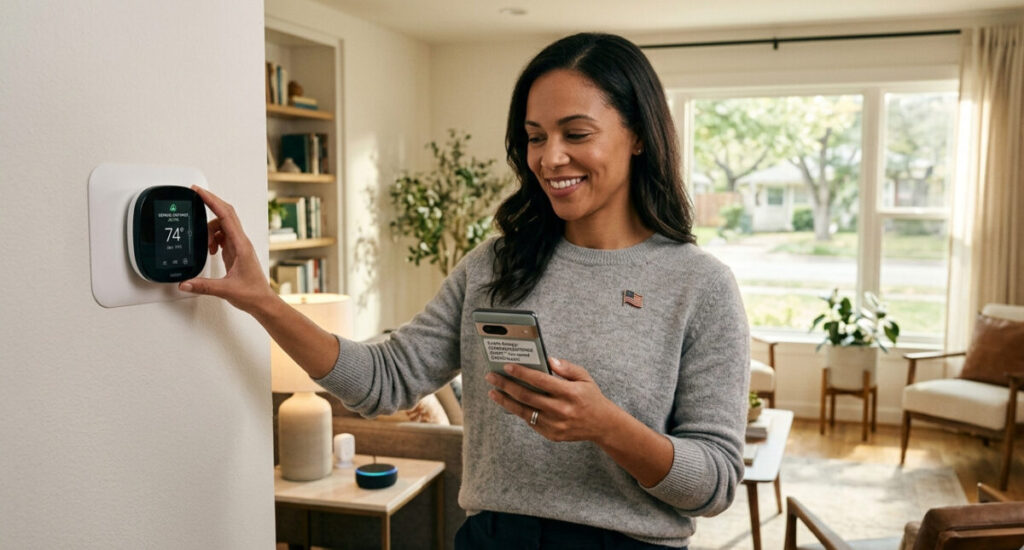

If you live in the United States, your monthly electric bill is likely one of your largest recurring expenses. However, most homeowners are unaware that their gadgets can actually earn them money. By tapping into various smart home energy incentives in the U.S., you can transform your home into a high-efficiency revenue stream.
The secret lies in a system called “Demand Response.” As the American power grid faces increased pressure, utility companies are now paying consumers to optimize their energy habits.
What are Smart Home Energy Incentives in the U.S.?
In the current U.S. energy landscape, smart home energy incentives are financial rewards offered by utility providers (like PG&E, Duke Energy, or ConEd) to homeowners who use IoT devices to reduce strain on the electrical grid.
These incentives typically come in three forms:
- Enrollment Rebates: Instant cash-back (often $50–$100) when you register a compatible smart thermostat.
- Performance Credits: Monthly or seasonal credits on your bill for participating in “OhmHours” or peak events.
- Tax Credits: Federal incentives for installing energy-efficient smart appliances under updated green energy legislation.
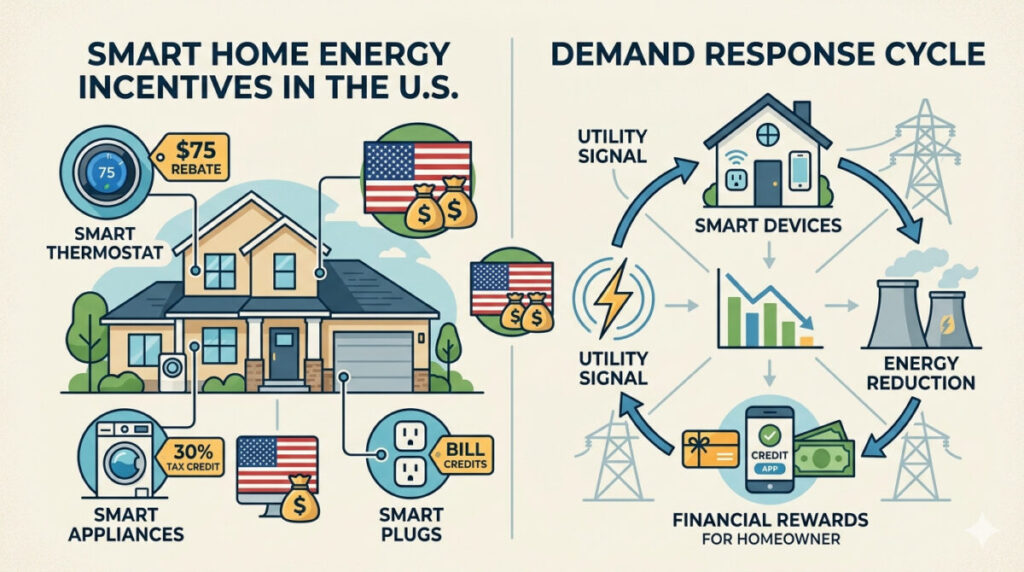
Top U.S. Demand Response Programs to Join
To capitalize on smart home energy incentives in the U.S., you should look into these verified platforms:
- OhmConnect: Available in California, Texas, and New York, this service syncs with smart plugs to pay you for saving energy during peak times.
- Nest Renew & Rush Hour Rewards: Google’s flagship program that works with local U.S. utilities to automatically adjust your temperature during high-demand periods.
- Ecobee Eco+: A suite of features that optimizes your HVAC schedule based on local time-of-use rates, a key part of many U.S. utility incentive structures.
How to Qualify for Incentives
To rank for smart home energy incentives in the U.S., your home must be equipped with “Grid-Aware” technology.
| Device Type | Recommended Models for U.S. Programs | Average Annual Incentive |
| Smart Thermostat | Nest Learning Thermostat, Ecobee Premium | $50 – $120 |
| Smart Plugs | Kasa Smart Plug, Wemo | $20 – $50 |
| Smart Water Heaters | Rheem EcoNet, A.O. Smith | $75 – $150 |
Why U.S. Homeowners Should Act Now
The U.S. power grid is undergoing a massive transition in 2026. Utility companies are more desperate than ever to avoid rolling blackouts, meaning the “bounties” for energy-saving behavior are at an all-time high.
By leveraging smart home energy incentives in the U.S., you aren’t just saving the planet—you are participating in a decentralized energy market that pays you for your efficiency.
Final Thoughts for IoT Beginners
Setting up these incentives is a “one-and-done” task. Once your devices are linked to your utility’s portal, the savings happen in the background. If you want to lower your electric bill this year, stop looking at your smart home as a luxury and start treating it as a financial asset.
Frequently Asked Questions (FAQ)
1. How much money can I actually save with smart home energy incentives in the U.S.?
While savings vary by state and provider, the average U.S. household can earn between $100 and $250 annually. This typically consists of a one-time enrollment rebate ($50–$100) for a smart thermostat, followed by ongoing seasonal participation credits ($20–$60 per season).
2. Can I participate in more than one Demand Response program at a time?
Generally, no. Most U.S. utility companies and third-party providers (like OhmConnect) require that your device is only registered to one program at a time. This prevents “double-dipping” on the same energy reduction event. However, you can often stack utility rebates with federal tax credits for purchasing energy-efficient appliances.
3. What happens if I want to override the temperature during a “Peak Event”?
You always have full control. If your utility provider adjusts your thermostat during a high-demand period and you feel uncomfortable, you can manually change the temperature at any time. While this may disqualify you from the specific reward for that day, it will not kick you out of the program or result in a penalty.
4. Are smart home energy incentives available for renters in the U.S.?
Yes! If you pay your own utility bill and have a Wi-Fi-connected smart device (like a plug-in smart heater or a portable AC unit connected to a smart plug), you can join programs like OhmConnect. Just ensure any permanent hardware installations, like a wall-mounted thermostat, are approved by your landlord.
5. Is my data safe when I join these energy programs?
Privacy is a top priority for major U.S. programs. Providers like Google Nest and Ecobee only share the specific data required to verify your energy reduction—such as device serial numbers and runtime data. They do not have access to your home cameras, microphones, or browsing history.
6. Do I need a specific type of internet connection?
Most smart home energy incentives in the U.S. require an “always-on” Wi-Fi connection. This allows the utility provider to send real-time signals to your devices during grid emergencies. If your internet goes down during an event, your device simply won’t participate, and you won’t earn credits for that specific window.
7. How do I receive my rewards?
Depending on the program, rewards are typically issued as:
- Bill Credits: Directly subtracted from your monthly utility statement.
- Digital Gift Cards: Sent via email (popular for Amazon or Target).
- Direct Deposits: Some programs like OhmConnect offer cash via PayPal or physical checks.
Link to the official EnergyStar.gov
or OhmConnect website
- On-Device AI in Smart Homes: Why 2026 Is the Year of Local Intelligence
 on-device AI – Smart homes are changing fast, and one of the biggest shifts in 2026 is happening inside the devices themselves. Instead of sending every command and camera clip to the cloud, more smart home products are now processing data locally for faster response, better privacy, and more reliable automation. For homeowners, this is…
 - Home Assistant for Beginners: Your First Step Away from Big Tech’s Smart HomeHome Assistant for beginners usually starts the same way: frustration. Maybe Google Home dropped a device for no reason. Maybe Alexa started asking for a subscription to use a feature that was free last year. Maybe a smart home brand you trusted announced it was shutting down its cloud servers, turning thousands of dollars of…
- What Data Do Smart Home Devices Collect? (And What Happens to It)What data do smart home devices collect? The honest answer is: far more than most people realise, far more than is necessary for the devices to do their jobs, and in many cases, far more than the average person would be comfortable with if they read the privacy policy in full. 82% of smart home…
- Digital Twins Explained: The Technology That Creates a Living Copy of EverythingDigital twins explained in one sentence: a digital twin is a living, continuously updated virtual replica of a real physical object, system, or process — connected to its real-world counterpart through sensors and data, updating in real time as the physical version changes. That definition is accurate, but it doesn’t quite capture why this technology…
- IoT Sensors Explained: What They Are, How They Work, and Where They’re Already in Your HomeIoT sensors explained simply: every smart device you own — your thermostat, your fitness tracker, your doorbell camera, your robot vacuum — relies on at least one sensor to do its job. Sensors are the reason smart devices are smart. Without them, a connected device is just a device. Yet most explanations of IoT sensors…