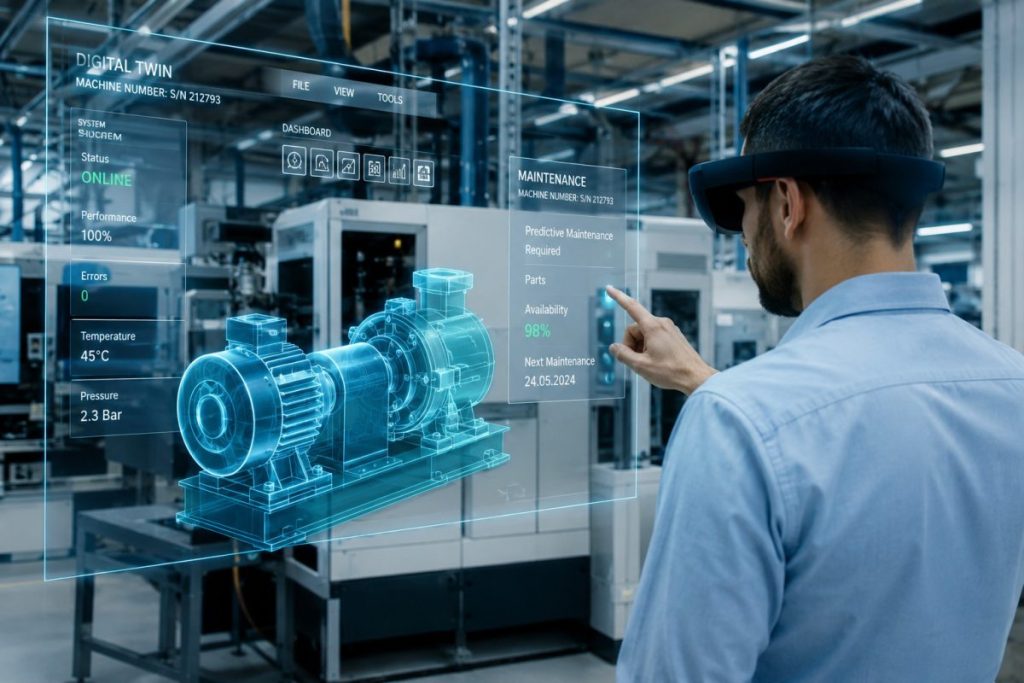

Digital twins explained in one sentence: a digital twin is a living, continuously updated virtual replica of a real physical object, system, or process — connected to its real-world counterpart through sensors and data, updating in real time as the physical version changes.
That definition is accurate, but it doesn’t quite capture why this technology is genuinely remarkable. So let’s try a different approach.
Imagine NASA engineers wanting to fix a problem on the International Space Station. They can’t exactly nip up there to have a look. But they have a complete digital twin of the station — every component, every system, every sensor reading — updated in real time from data the station transmits. They can simulate the problem, test solutions, and verify fixes in the digital model before attempting anything on the physical station 250 miles above Earth.
That’s the power of a digital twin. And while space stations are a dramatic example, the same principle is now being applied to cars, cities, buildings, factories, hospitals — and increasingly, to your home and your body.
What Makes a Digital Twin Different from a Regular 3D Model?
This is the question most people have once they hear the concept — and it’s the right one to ask.
A regular 3D model or simulation is static. It represents what something looks like or how it’s designed to behave. It doesn’t update when the real thing changes. It doesn’t know what’s happening to the physical object right now.
A digital twin is alive. It’s connected to its physical counterpart through sensors and data streams, receiving continuous updates that reflect the real-world state of the object at every moment. When the physical thing changes — its temperature rises, a component wears down, its location shifts — the digital twin reflects that change in real time.
Three things define a true digital twin:
Real-time data connection: Sensors on the physical object continuously feed data to the digital model. The twin always reflects the current state of reality, not a historical snapshot.
Bidirectional relationship: It’s not just the physical informing the digital. The digital twin can be used to test changes, run simulations, and optimise behaviour — and those insights are fed back to improve the physical object.
Predictive capability: Because the twin accumulates historical data alongside real-time data, it can model future states. It doesn’t just tell you what’s happening now — it can tell you what’s likely to happen next.
This combination of real-time awareness, simulation capability, and predictive intelligence is what makes digital twins a genuinely transformative technology rather than just an advanced visualisation tool.
How Digital Twins and IoT Work Together
Digital twins and IoT are inseparable technologies. AI digital twins are virtual representations of physical objects or systems powered by artificial intelligence and live data. These digital models continuously update using sensors and analytics to reflect real-world conditions.
IoT provides the nervous system — the sensors and connectivity that feed real-world data into the digital model. Without IoT sensors monitoring temperature, pressure, location, movement, and countless other variables, a digital twin would have no way of knowing what its physical counterpart is doing.
The relationship works like this:
- IoT sensors on the physical object collect data continuously
- Connectivity (Wi-Fi, 5G, cellular) transmits that data to the cloud
- The digital twin platform receives, processes, and integrates the data into the virtual model
- AI and analytics run on the twin to identify patterns, predict failures, and simulate scenarios
- Insights and optimisations are fed back to the physical object — adjusting settings, triggering maintenance, or informing human decisions
A factory machine can have a digital twin that monitors temperature, performance, and maintenance needs. Engineers can test scenarios digitally before making physical changes. The same principle scales from a single machine to an entire factory, city, or ecosystem.
Digital Twin Examples in the Real World
The concept clicks when you see it applied to specific, recognisable situations. Here are the most compelling real-world examples — from industrial to consumer:
Your Car
Modern connected vehicles are among the most advanced consumer digital twin applications in existence. Every Tesla has a digital twin maintained by Tesla’s servers — continuously updated with data from the car’s hundreds of sensors measuring battery state, motor performance, software version, driving patterns, and component health.
When Tesla pushes an over-the-air software update, it’s been tested on digital twins of millions of vehicles before reaching your car. When your car reports an unusual sensor reading, Tesla engineers can examine the digital twin to diagnose the issue without ever seeing the physical vehicle. When a new feature is developed, it’s simulated on the digital fleet before deployment.
This is why Tesla can improve the performance of cars that are already sold and on the road — the digital twin enables continuous optimisation of the physical product after it leaves the factory.
Other manufacturers including Ford, GM, and BMW are building similar capabilities. Connected car digital twins will become standard across the industry within this decade.
Smart Buildings and Homes
Digital twins are moving from experimentation into everyday building operations, with 2026 shaping up to be a pivotal year for adoption. Building digital twins integrate data from HVAC systems, lighting, security, occupancy sensors, energy meters, and structural monitors to create a living model of the building that facilities managers can use to optimise every system.
A hospital with a digital twin can simulate what happens to patient flow if one ward closes. An office building can model energy consumption under different occupancy patterns. A skyscraper can monitor structural stress in real time and predict maintenance needs years in advance.
At the residential scale, early versions of home digital twins are already emerging. Smart home platforms like Home Assistant are effectively building primitive digital twins of individual homes — aggregating sensor data from thermostats, lighting, energy monitors, and security devices into a unified model of the home’s state. As sensor coverage increases and AI processing improves, the home digital twin will become a meaningful concept for ordinary homeowners.
Smart Cities
Several US cities and many international ones are developing city-scale digital twins — virtual replicas of urban infrastructure that enable planners and managers to simulate the impact of changes before implementing them.
Singapore has the most advanced national digital twin in the world — a real-time 3D model of the entire city-state that integrates data from thousands of sensors monitoring traffic, utilities, buildings, and environmental conditions. City planners use it to simulate the impact of new developments, model flood risk, and optimise public transport routing.
In the US, cities including Las Vegas, Boston, and Orlando have implemented partial digital twins for specific infrastructure — traffic management systems, utility networks, and emergency response planning. The combination of new businesses, jobs, information, and data analysis that digital twins enable will create entirely new career paths and revenue streams.
Healthcare and the Body
Bio-digital twins are changing the way we think about health by creating a virtual mirror of your body. These models combine information from your wearable gadgets and medical scans with your unique genetic code.
The concept of a personalised health digital twin — a continuously updated virtual model of your specific body — is moving from research labs toward clinical applications. Unlike a standard medical diagram, a genomic twin is based entirely on your specific DNA, allowing healthcare professionals to understand exactly how your body might respond to a new diet or a specific type of medicine before you ever take a dose.
Less futuristically, the Apple Watch and Fitbit already maintain personal health models updated by continuous sensor data — tracking heart rate, sleep patterns, activity levels, and now blood oxygen and ECG readings. These aren’t full digital twins in the engineering sense, but they’re the consumer-facing early version of the same concept. As wearable sensors improve and AI processing becomes more sophisticated, the personal health digital twin will become a standard tool in preventive healthcare.
Hospitals use AI digital twins to simulate patient treatment plans, hospital operations, and resource allocation — allowing doctors to test decisions virtually before applying them to real patients.
Manufacturing and Industry
Manufacturing is where digital twins originated and where they’re most mature. GE Aviation maintains digital twins of every jet engine it manufactures — continuously updated with flight data from the engine’s sensors. The twin monitors component wear, predicts maintenance needs, and has reportedly prevented numerous in-flight failures by flagging issues before they became critical.
Siemens, one of the pioneers of industrial digital twins, offers a complete digital twin platform that connects product design, manufacturing processes, and in-service performance into a continuous loop. A product designed in the digital environment can be validated in simulation before a physical prototype is ever built — compressing development cycles from years to months.
The Four Types of Digital Twins
As the technology has matured, digital twins have been categorised by what they represent and the level of complexity they model:
Component Twins — the simplest type. A digital replica of a single component — a pump, a sensor, a motor. The starting point for most digital twin implementations.
Asset Twins — a digital replica of a complete asset made up of multiple components working together. A jet engine, a wind turbine, a piece of medical equipment. The relationships between components are modelled, enabling system-level analysis.
System Twins — multiple assets working together as a system. A factory floor, a building’s HVAC system, a city’s water network. System twins reveal how assets interact and enable whole-system optimisation.
Process Twins — the most complex type, representing entire processes rather than physical objects. A supply chain, a hospital’s patient flow, a city’s traffic management system. Process twins model how systems interact over time and under different conditions.
Consumer applications today mostly exist at the component and asset level — your car, your wearable, your smart appliance. System and process twins are where the technology is most powerful and where development is most active.
Digital Twins vs Simulation: What’s the Difference?
A common point of confusion is how digital twins differ from conventional computer simulations. The distinction is important:
| Traditional Simulation | Digital Twin | |
|---|---|---|
| Data source | Historical or assumed data | Real-time sensor data |
| Update frequency | Static or periodic | Continuous |
| Reflects reality | At time of creation | Always current |
| Predictive ability | Based on models | Based on actual behaviour |
| Bidirectional | No | Yes |
| Personalised | Generic | Specific to this exact object |
A traditional simulation of a bridge uses engineering calculations and assumed load data to model behaviour. A digital twin of the same bridge uses real-time data from embedded sensors measuring actual stress, temperature, vibration, and deflection — and updates its model continuously based on what the sensors report. When an unusual load event occurs, the twin captures it. When material fatigue begins, the twin detects it. The simulation never knew any of this happened.
What Digital Twins Mean for You in 2026
By 2026, many people may have access to digital twins without realising it, using apps and wearables that learn habits, predict needs, and respond to real-world data.
The consumer experience of digital twins in 2026 is mostly invisible — it happens inside the products you use rather than as a distinct technology you interact with. But understanding it matters for several practical reasons:
It explains why connected products get better over time. When your car, your smart appliance, or your fitness tracker improves its behaviour without you doing anything, it’s often because the manufacturer is running your device’s digital twin to identify optimisations and pushing them back to the physical product.
It explains the value of sensor data. The more sensor data a digital twin has access to, the more accurate and useful it becomes. This is why manufacturers want to collect data from their products — and why understanding what data your devices share is increasingly important.
It shapes what to look for in smart home products. Products from manufacturers who maintain active digital twins of their devices tend to improve over time, receive predictive maintenance alerts, and benefit from fleet-wide learning. Products from manufacturers who don’t tend to be static — the product you bought is the product you’ll always have.
It previews what’s coming. The digital twin market is transitioning from a niche technical tool to an essential component of operational strategy. As the technology matures and costs fall, digital twins will become a standard feature of smart home platforms — giving homeowners a real-time model of their home’s energy use, system health, and maintenance needs that currently only building managers have access to.
The Market Behind Digital Twins
The numbers reflect how seriously the technology industry is taking this:
- The global digital twin market was valued at approximately $17 billion in 2024
- It is projected to exceed $110 billion by 2030, growing at over 30% annually
- Nearly 60% of executives plan to integrate digital twins into core operations by 2028
- North America leads adoption, accounting for the largest regional market share
- Healthcare, manufacturing, and smart cities are the three fastest-growing application sectors
This growth trajectory reflects a technology moving from early adoption into mainstream deployment — the same arc that IoT itself followed between 2010 and 2020.
Challenges and Limitations
Digital twins are powerful, but not without genuine challenges that are worth understanding honestly:
Data volume and quality: A meaningful digital twin requires continuous, high-quality sensor data. In environments with poor connectivity or limited sensors, the twin’s accuracy degrades. The twin is only as good as the data feeding it.
Complexity and cost: Building and maintaining a sophisticated digital twin requires significant engineering effort. At the industrial scale, this is often justified by the value generated. At the consumer scale, the cost is embedded in the product price — which is why the most capable digital twin applications exist in premium vehicles and high-end smart appliances.
Privacy: A digital twin of your home, your car, or your body contains intimate data about your life. Who owns that data, how it’s stored, and who can access it are questions that regulation is still catching up with.
Cybersecurity: A digital twin that can influence its physical counterpart is also a potential attack surface. Compromising a digital twin could theoretically allow an attacker to manipulate the physical system it represents — a risk that becomes more serious as digital twins control more critical infrastructure.
Final Thoughts
Digital twins are one of the most conceptually interesting technologies in active development — and one that most people will benefit from without ever knowing the term. Your connected car is already living inside a digital twin. Your city’s traffic management system may be too. Your personal health data is moving toward it.
Over the coming years, the term “digital twin” will likely disappear as it becomes as common as GPS, FaceTime, and Spotify. The technology will simply become how things work — how products improve, how cities are managed, how healthcare is personalised, how homes are maintained.
Understanding it now, while it’s still emerging, gives you a meaningful head start on what the connected world is becoming.
- Digital Twins Explained: The Technology That Creates a Living Copy of Everything
- IoT Sensors Explained: What They Are, How They Work, and Where They’re Already in Your Home
- Matter 1.4 vs Zigbee vs Z-Wave: Best Smart Home Protocol for US Homes in 2026
- Best Cellular IoT Data Plans for US Makers in 2026: Hologram vs Twilio vs Soracom Tested
- Smart Home Energy Saving: How to Cut Your Electricity Bill in 2026
Published on KontraNet IoT Hub — Your beginner-friendly guide to smart living and connected tech.

ISS Is Reaching the End of Its Life?

Best Linux Distro for Developers in 2026
Updated: May 2026 | Covers web dev, DevOps, data science, security, embedded and general purpose Ask…
Best Linux Distros for Privacy and Security in 2026
Privacy in 2026 is not a nice-to-have — it’s a necessity. Windows 11 phones home constantly. m…