
UPDATED!!! – May 2026
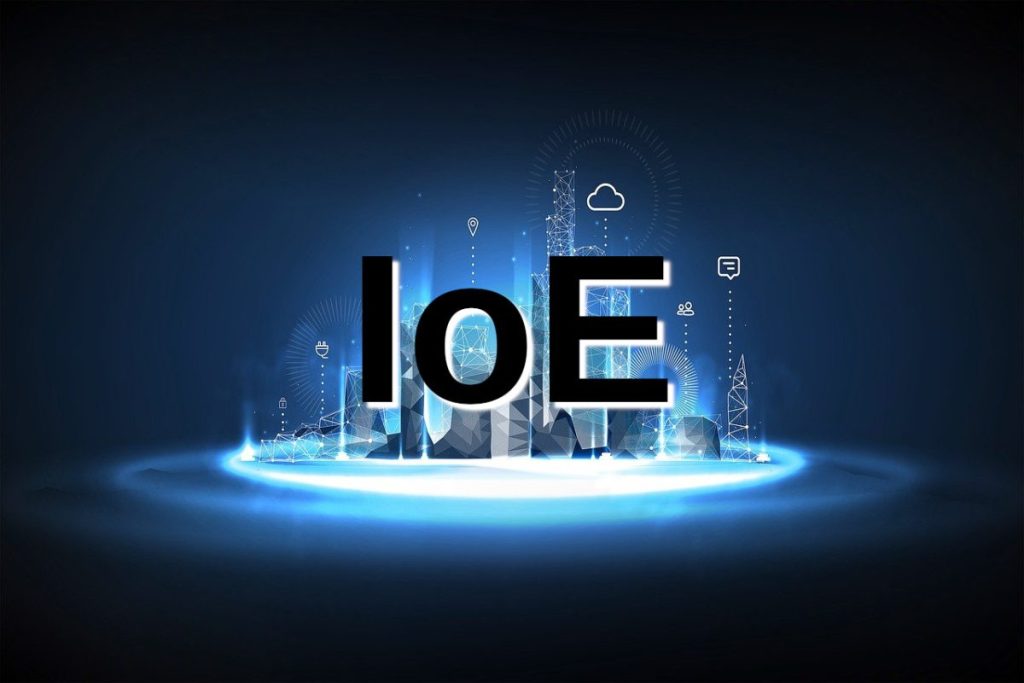
The Internet of Things gave us smart thermostats and Alexa. But in 2026, the real shift in US homes and cities isn’t just more devices — it’s the Internet of Everything (IoE).
Coined by Cisco, IoE doesn’t just connect things. It connects four pillars: people, things, data, and processes. The result? Systems that predict, adapt, and act without you asking. Think: your EV, calendar, traffic data, and power grid coordinating to charge your car cheapest and have it warm by 7am.
If IoT was the nervous system, IoE is the brain. Here’s what it means for 2026 and how it’s already rolling out across the US.
IoE vs IoT: What’s the Real Difference?
| Feature | IoT – Internet of Things | IoE – Internet of Everything |
|---|---|---|
| Connects | Devices to internet | People + Devices + Data + Processes |
| Goal | Collect data, remote control | Create insights + autonomous action |
| Example | Smart thermostat you control via app | HVAC + weather + energy prices + your calendar = auto-adjusts to save $300/yr |
| Intelligence | Reactive | Predictive + Cognitive |
| US Market Size 2026 | $1.1T | $4.3T projected |
Key takeaway: IoT asks “what’s happening?” IoE asks “what should happen next?”
The 4 Pillars of IoE Explained with 2026 Examples
1. People: You’re a node. Your health watch, location, and preferences feed the system.
US Example: Apple Watch detects irregular heart rhythm → pings your doctor → auto-books Uber Health if needed.
2. Things: Same IoT devices, but now context-aware.
US Example: John Deere tractors in Iowa use soil data + weather + crop prices to auto-adjust planting depth.
3. Data: Not just big data — right data, delivered in real time.
US Example: PG&E in California uses smart meter + wildfire risk data to preemptively shut off grids in specific blocks only.
4. Processes: Business and life workflows that adapt.
US Example: Amazon warehouses reroute robots + staff based on live order volume, traffic, and even employee fatigue data.
12 Internet of Everything Examples in the USA Right Now
- Smart Cities – Chattanooga, TN: Traffic lights talk to ambulances + Waze data to create green corridors. EMS response time down 20%.
- Retail – Walmart: Shelves + POS + supply chain + weather = auto-restock snow shovels before a storm hits Texas.
- Healthcare – Mayo Clinic: Patient wearables + EHR + doctor schedules = AI triages who needs to be seen in 10 min vs tomorrow.
- Agriculture – California Almond Farms: Drones + soil sensors + water rights data = cuts water use 30%.
- Energy – Tesla Virtual Power Plant: Your Powerwall + 50,000 others + grid demand = sells energy back during peak $/kWh hours.
- Transportation – UPS ORION 2.0: Delivery route + traffic + weather + customer “out of office” calendar = saves 10M gallons of fuel/yr.
- Home – Google Nest 2026: Links your calendar + sleep data + local energy rates to pre-cool house only when you’re actually coming home.
- Manufacturing – Ford F-150 Plant: Robot arms + supplier delays + quality scans = reroutes production in real time.
- Education – ASU Smart Campus: Student ID + class schedule + room temp + crowd density = auto-assigns study rooms.
- Insurance – State Farm Drive Safe: Your car + phone + weather + traffic tickets = dynamic premium each month.
- Public Safety – Las Vegas: Gunshot sensors + CCTV + police GPS = auto-dispatch + drone launch in 90 seconds.
- Consumer – Living Intelligence: Your fridge sees you’re low on milk, checks Instacart prices, knows you’re home at 6pm, orders it for 5:55pm delivery.
“Living Intelligence” – The Next Phase After IoE
You searched living intelligence — here’s the link. Coined in 2025, Living Intelligence is IoE + AI agents. Systems don’t just connect; they learn your intent.
IoT: “Garage door is open.”
IoE (Internet of Everything): “Garage door open + you left 10 min ago + 9pm = security risk, notify you.”
Living Intelligence: “You usually close it, but today you have guests coming. I’ll leave it open and disarm entry alerts until 11pm.”
This is where the US market is heading 2026-2028.
FAQs – People Also Ask
Q: Is IoE the same as AI?
No. AI is the brain. IoE is the nervous system + body + environment that feeds the brain. IoE needs AI to work, but IoE is bigger.
Q: What comes after the Internet of Everything?
Most researchers point to “Living Intelligence” or “Ambient Computing” — where tech disappears and environments just respond to you.
Q: Is IoE real or just marketing?
Real. The US Department of Energy, Walmart, John Deere, and Tesla all have active IoE deployments. The term is marketing, but the tech stack is real.
Q: How can I invest in IoE companies?
Look at US firms in edge AI, industrial IoT, and data orchestration: NVDA, CRWD, SPLK, and private players like C3.ai. Not financial advice.
Why IoE Matters for Your Smart Home in 2026
If you’re building a smart home, stop thinking device-by-device. Think process:Wake up → Coffee starts → News reads → Heat adjusts → Car preconditions
That’s not 5 automations. That’s one IoE process triggered by your alarm. Matter 1.4 + Home Assistant 2026 are the first US-friendly tools to do this.
Want the step-by-step to build your first IoE process? See our updated guide: Best Smart Home Programming Languages 2026.
- Home Assistant for Beginners: Your First Step Away from Big Tech’s Smart Home
 Home Assistant for beginners usually starts the same way: frustration. Maybe Google Home dropped a device for no reason. Maybe Alexa started asking for a subscription to use a feature that was free last year. Maybe a smart home brand you trusted announced it was shutting down its cloud servers, turning thousands of dollars of…
 - What Data Do Smart Home Devices Collect? (And What Happens to It)What data do smart home devices collect? The honest answer is: far more than most people realise, far more than is necessary for the devices to do their jobs, and in many cases, far more than the average person would be comfortable with if they read the privacy policy in full. 82% of smart home…
- Digital Twins Explained: The Technology That Creates a Living Copy of EverythingDigital twins explained in one sentence: a digital twin is a living, continuously updated virtual replica of a real physical object, system, or process — connected to its real-world counterpart through sensors and data, updating in real time as the physical version changes. That definition is accurate, but it doesn’t quite capture why this technology…
- IoT Sensors Explained: What They Are, How They Work, and Where They’re Already in Your HomeIoT sensors explained simply: every smart device you own — your thermostat, your fitness tracker, your doorbell camera, your robot vacuum — relies on at least one sensor to do its job. Sensors are the reason smart devices are smart. Without them, a connected device is just a device. Yet most explanations of IoT sensors…
- Matter 1.4 vs Zigbee vs Z-Wave: Best Smart Home Protocol for US Homes in 2026By KontraNet IoT Hub | Last Updated: June 3, 2026 | Reading time: 11 min Quick Pick for US Homeowners in 2026 Use this table if you just need the answer fast: Your Situation Best Protocol in 2026 Why It Wins for US Homes Apple + Google + Alexa household Matter 1.4 over Thread All 3 ecosystems control the…


Best Linux Distro for Developers in 2026