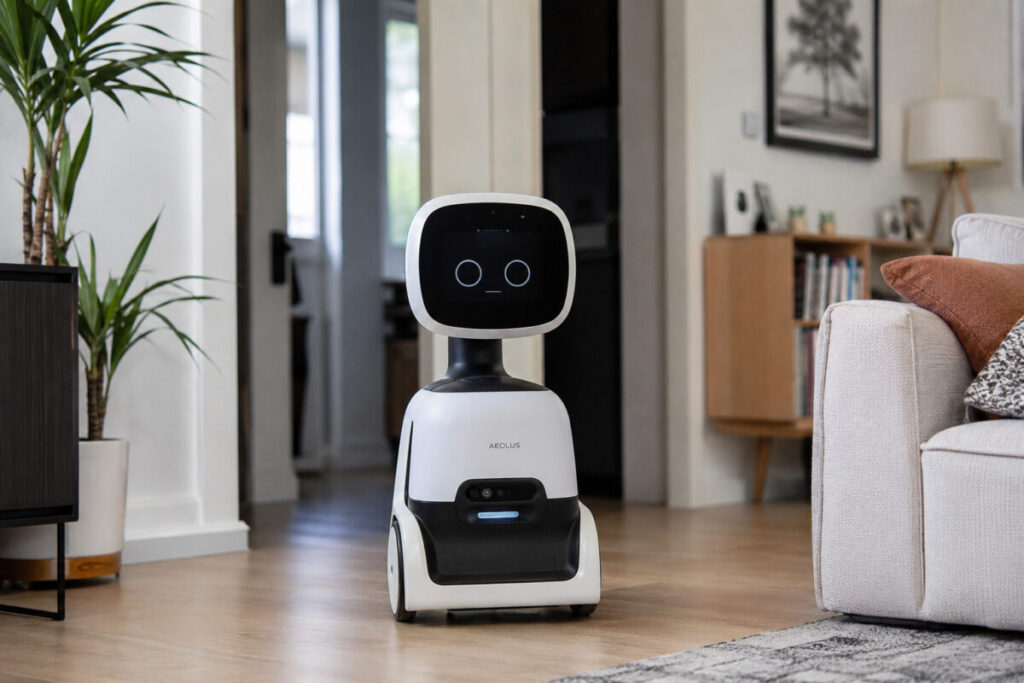

AI home companion robots stopped being a sci-fi punchline this year. At CES 2026 in Las Vegas, LG showed off a robot with two arms and five-fingered hands folding laundry on stage. Samsung unveiled a full ecosystem of appliances it’s now calling “home companions” instead of appliances. And a startup founded by the co-creator of the Roomba launched a furry, dog-sized robot designed specifically to bond with your family emotionally.
This isn’t another round of robot vacuums with a new paint job. Something genuinely different is happening in home robotics in 2026 — and it comes with a trade-off most of the coverage isn’t mentioning.
What Actually Happened at CES 2026
CES 2026 unveiled a new era of smart home technology, with smart home products that think for you rather than simply respond to commands. Three announcements stood out as genuinely significant rather than just incremental upgrades.
LG CLOiD: The Robot With Hands
LG unveiled CLOiD, an AI-powered home robot that takes care of household chores like cooking and laundry, debuted on stage as part of the company’s CES keynote presentation. What makes CLOiD different from previous home robot attempts is genuinely in the hardware — it features two articulated arms with five individually actuated fingers, with the arms operating on seven degrees of freedom for human-like motion.
In live demos, CLOiD folded laundry — slowly, and towels had to be pre-arranged for it — grabbed a carton of milk from the fridge, and coordinated with another robot in the room, telling it to clean up a mess it had visually detected on the floor. None of this was flawless. The milk never made it into a glass during the demo. But it represented something LG’s previous home robot attempt — a wheeled 2024 model one reviewer called “kinda cute and kinda useless” — never came close to achieving: actual physical manipulation of real household objects.
LG calls the AI behind it “Affectionate Intelligence” — designed to understand and empathise with the people it serves, according to Steve Baek, president of home appliance solutions at LG. The stated ultimate goal is a “zero labour home.”
Samsung’s “Companion to AI Living”
Samsung’s approach is less about a single robot and more about reframing its entire appliance lineup. The company’s Bespoke AI Refrigerator Family Hub does more than keep food cold — it tracks your groceries, recommends recipes, and uses Google Gemini integration to bring AI vision directly into the fridge, recognising ingredients and analysing food usage to reduce waste.
Paired with this is the Bespoke AI Jet Bot Steam Ultra robot vacuum, which uses an Active Stereo 3D Sensor to recognise liquids — including transparent ones like water — while its camera doubles as a home monitoring tool that can notify you about pets or suspicious activity while you’re away. With a smarter Bixby integration, you can speak conversationally to the vacuum to direct its tasks.
Samsung’s CEO, TM Roh, framed the shift explicitly: the company’s vision is to evolve from providing home appliances to true home companions that work to eliminate the stress of daily chores. Notably, Samsung also partnered with insurance company Hartford Steam Boiler — hinting at future home insurance discounts tied to smart home monitoring data, a development worth watching closely.
1X NEO: The Humanoid You Can Actually Order
The most striking announcement wasn’t from an appliance giant at all. 1X, a robotics startup, launched NEO — described as the world’s first consumer-ready humanoid robot designed to transform life at home, now available for pre-order with deliveries beginning in 2026.
NEO can be given a list of chores to complete on a schedule, handling tasks like folding laundry, organising shelves, and tidying spaces — either while you’re out or in real time alongside you. It includes a built-in large language model, letting owners have natural conversations with it and ask for help with everyday questions, and uses what 1X calls Audio Intelligence to recognise when it’s being addressed rather than responding to every sound in the room.
The pricing illustrates exactly how early-stage this technology still is: Early Access pre-orders cost $20,000, with priority delivery in 2026. A subscription option also exists at $499 per month for a later shipping slot. This is firmly early-adopter pricing — but the fact that a humanoid home robot is purchasable at all, rather than a research demo, marks a genuine threshold being crossed.
Why This Is Happening Now
Home robotics has tried and stumbled before — plenty of “smart” robot concepts at past CES events turned out to be little more than art installations with wheels. What’s different in 2026 comes down to two converging technologies finally being good enough simultaneously.
AI that understands context, not just commands. Earlier home robots could follow simple programmed instructions. The current generation uses large language models and computer vision working together — meaning CLOiD can “see” a mess and decide to delegate cleaning it to another device, rather than needing that scenario explicitly programmed in advance.
Physical manipulation finally catching up. The hard problem in home robotics has never really been intelligence — it’s been hands. Grasping a towel, recognising it’s a towel, folding it correctly, and not crushing a wine glass while doing so requires a level of fine motor coordination that’s taken the robotics industry decades to approach. CLOiD’s five individually actuated fingers per hand and NEO’s dexterous manipulation represent genuine engineering breakthroughs, not marketing dressing.
The result is a wave of home robots that, while still imperfect, are crossing from novelty into genuine — if expensive — utility.
The Part Most Coverage Is Skipping: Privacy
Here’s where this story gets genuinely important rather than just exciting.
Companion and humanoid home robots are arriving across the industry, from 1X’s NEO to LG’s CLOiD and Samsung’s tabletop concepts, each pairing chores or companionship with always-on cameras, microphones and sensors. That’s a meaningfully different privacy proposition than a smart speaker sitting in one corner of your kitchen.
Robotics-law scholar Ryan Calo, a University of Washington law professor, frames the risk in three parts: direct surveillance, because robots sense and record their surroundings; increased access, because they physically enter intimate spaces other devices simply can’t reach; and social meaning, because we instinctively treat robots as social beings rather than appliances.
That third point deserves real attention, because it’s genuinely novel. You don’t form an emotional bond with your Wi-Fi router. You might with something that has eyes, responds to your voice with apparent warmth, and follows you from room to room. One particularly striking example: a startup founded by Colin Angle — the co-creator of the original Roomba — built a furry, dog-sized companion robot deliberately designed with bear-cub ears and large, doe-like eyes specifically to encourage emotional attachment. It runs an on-device AI model fusing vision, audio, language, and memory to “bond socially” with the household while logging information about its members.
The mechanism of concern here is straightforward: an emotional bond functions as a quiet form of persuasion. When you love a device, you’re more inclined to accept its prompts and far less inclined to scrutinise what it’s capturing or where that data ultimately travels. A robot designed to be adorable is, by the same design choice, a robot you’re less likely to interrogate.
This doesn’t mean home companion robots are secretly sinister. It means the convenience-privacy trade-off that’s applied to every smart home device for the past decade just got considerably more intimate — quite literally, since these devices move through your home, see into rooms a fixed camera never would, and are built specifically to feel like part of the family.
What This Means If You’re Not Buying a $20,000 Robot Anytime Soon
Realistically, most people reading this aren’t pre-ordering NEO this year. But the trends behind these flagship robots are already trickling into far more affordable devices you might actually buy in 2026:
Robot vacuums are gaining “companion” features. Samsung’s Jet Bot Steam Ultra monitoring your pets and detecting suspicious activity while you’re away is a feature that will appear in mid-range vacuums within a product cycle or two. If you own — or are considering — a robot vacuum with a camera, the privacy considerations from this article apply directly.
Voice assistants are becoming more conversational and proactive. The “Affectionate Intelligence” framing LG uses for CLOiD reflects a broader industry shift toward AI that initiates interaction rather than only responding to commands. Expect your existing smart speakers to feel noticeably more “present” over the next product generation.
Kitchen appliances are becoming AI vision platforms. Samsung’s Family Hub fridge recognising ingredients via camera is the leading edge of a trend that will reach mid-range refrigerators, and eventually other kitchen appliances, over the next few years.
The insurance angle is worth watching closely. Samsung’s partnership with Hartford Steam Boiler hints at a future where smart home monitoring data could factor into home insurance pricing — a genuinely significant development with implications well beyond home robotics specifically.
A Practical Framework for Evaluating Any Home Robot
As this category matures and prices inevitably fall, here’s a useful checklist for any AI companion robot or robot-adjacent appliance you’re considering:
What sensors does it actually have? Camera, microphone, and motion sensors should each be itemised in the spec sheet — and you should know exactly what each one captures.
Where is the processing happening? On-device (local) processing, like the custom AI model running inside the Familiar robot, generally means less data leaving your home compared to cloud-dependent processing.
Can you review and delete what it’s captured? Just as with smart cameras and voice assistants, a genuinely trustworthy companion robot should let you audit and erase its memory of your household.
What’s the actual utility versus the emotional appeal? Ask honestly whether you’re drawn to the practical chore automation or to the robot’s personality and apparent warmth. There’s nothing wrong with wanting companionship from technology — but knowing which one is driving your purchase helps you evaluate the privacy trade-off honestly.
Who manufactures it, and what’s their track record? A robot from an established appliance brand with a public privacy policy and years of regulatory scrutiny carries a different risk profile than a robot from a brand-new startup still building its first product.
Final Thoughts
AI home companion robots crossing from research lab into purchasable product is a genuine inflection point in home technology — comparable to when the first smart speakers reached mass adoption a decade ago. LG’s CLOiD, Samsung’s reimagined appliance ecosystem, and 1X’s NEO each represent real engineering progress, not just marketing repackaging of existing robot vacuums.
But the same lesson that applies to every other connected device in your home applies here, amplified: the more capable and endearing a device becomes, the more carefully its data practices deserve scrutiny — not less. A robot designed to be loved is still a computer with a camera and a microphone, moving freely through the most private spaces in your home.
The technology is genuinely impressive. Approach it with the same informed curiosity you’d bring to any other smart home purchase — just with the dial on privacy awareness turned up to match how much closer it’s about to get.
Related reading: AIoT: What Happens When Your Smart Home Gets a Brain | What Data Do Your Smart Home Devices Collect? | Smart Home Devices for Seniors: Stay Safe and Independent
Published on KontraNet IoT Hub — Your beginner-friendly guide to smart living and connected tech.
- AI Home Companion Robots Are Here: What CES 2026 Revealed About Your Future Living Room
 AI home companion robots stopped being a sci-fi punchline this year. At CES 2026 in Las Vegas, LG showed off a robot with two arms and five-fingered hands folding laundry on stage. Samsung unveiled a full ecosystem of appliances it’s now calling “home companions” instead of appliances. And a startup founded by the co-creator of…
 - On-Device AI in Smart Homes: Why 2026 Is the Year of Local Intelligenceon-device AI – Smart homes are changing fast, and one of the biggest shifts in 2026 is happening inside the devices themselves. Instead of sending every command and camera clip to the cloud, more smart home products are now processing data locally for faster response, better privacy, and more reliable automation. For homeowners, this is…
- Home Assistant for Beginners: Your First Step Away from Big Tech’s Smart HomeHome Assistant for beginners usually starts the same way: frustration. Maybe Google Home dropped a device for no reason. Maybe Alexa started asking for a subscription to use a feature that was free last year. Maybe a smart home brand you trusted announced it was shutting down its cloud servers, turning thousands of dollars of…
- What Data Do Smart Home Devices Collect? (And What Happens to It)What data do smart home devices collect? The honest answer is: far more than most people realise, far more than is necessary for the devices to do their jobs, and in many cases, far more than the average person would be comfortable with if they read the privacy policy in full. 82% of smart home…
- Digital Twins Explained: The Technology That Creates a Living Copy of EverythingDigital twins explained in one sentence: a digital twin is a living, continuously updated virtual replica of a real physical object, system, or process — connected to its real-world counterpart through sensors and data, updating in real time as the physical version changes. That definition is accurate, but it doesn’t quite capture why this technology…





The Symbiotic Relationship Between Android and Linux
Android, the widely popular mobile operating system, shares a deep and symbiotic relationship with Linux, a powerful and versatile open-source operating system. Understanding the connection between these two platforms is essential to appreciate the evolution and collaborative efforts that have shaped the landscape of mobile computing. Android’s Foundation Android, developed by the Open Handset Alliance… Read More »

Best Identity Theft Protection Services 2026: Aura, LifeLock, and More Compared
Identity theft isn’t a fringe risk anymore. Losses from online scams jumped from under $4 mill…
Run AI Locally on Your PC in 2026
A Beginner’s Guide to Private AI For years, artificial intelligence has mostly lived in the cloud. Y…