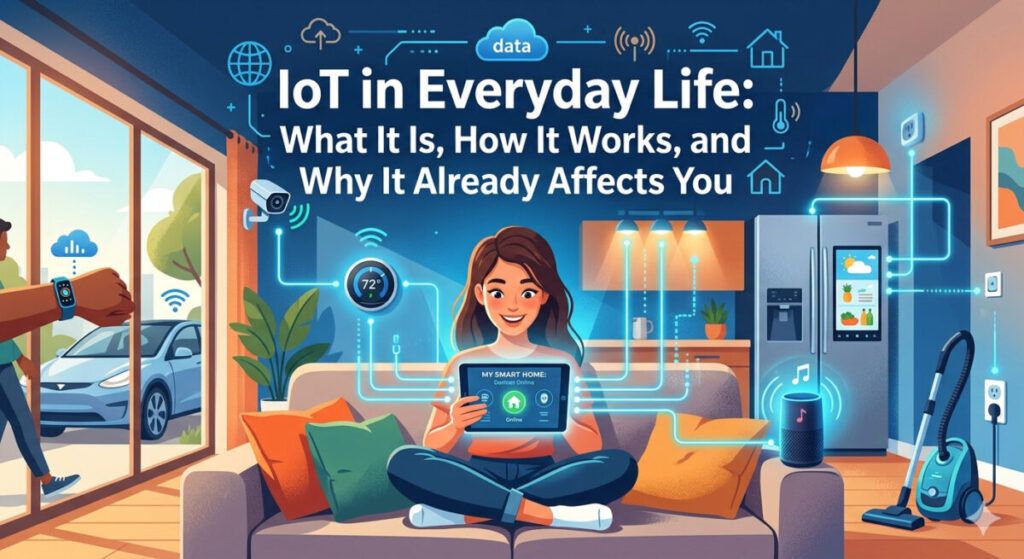

IoT in Everyday Life – You woke up this morning and IoT was already working.
Maybe your thermostat had already warmed the house before your alarm went off — because it learned your schedule weeks ago. Maybe your fitness tracker quietly recorded your sleep quality and synced the data to your phone before you even opened your eyes. Maybe your coffee maker started brewing at 7:00am because you set it from your phone the night before.
The Internet of Things isn’t a futuristic concept. It’s already woven into ordinary American life — in homes, cars, hospitals, farms, and cities — and most people interact with it multiple times a day without thinking about it.
This guide explains what IoT actually is, how it works under the hood, and where you’re already encountering it in your daily life. No technical background required.
What Is IoT? The Plain English Version
The Internet of Things (IoT) is a network of physical objects — devices, appliances, vehicles, sensors — that are connected to the internet and can collect, share, and act on data without requiring a human to operate them directly.
The “things” in Internet of Things are everyday objects that have been given two new capabilities: the ability to sense their environment (through sensors), and the ability to communicate what they sense (through internet connectivity).
A regular thermostat does one thing: it keeps the temperature at whatever you manually set it to. A smart thermostat — an IoT device — does something fundamentally different. It senses the temperature, checks your location on your phone, learns your daily routine over time, consults the weather forecast, and adjusts itself automatically. You set it once and forget it exists.
That’s the core idea of IoT: objects that were previously passive become active participants in your life, collecting information about the world around them and taking action based on that information — often without you doing anything at all.
How Does IoT Actually Work?
Every IoT device, whether it’s a $15 smart plug or a $500 connected car system, works through the same basic chain:
1. Sense — A sensor detects something about the physical world. Temperature, motion, light, humidity, sound, location, heart rate, air quality — sensors can measure almost anything.
2. Connect — The device sends that sensor data over a network. This could be your home Wi-Fi, Bluetooth, cellular (4G/5G), or lower-power protocols like Zigbee or Z-Wave designed specifically for smart home devices.
3. Process — The data goes somewhere to be interpreted. Sometimes this happens locally on the device itself (called edge computing). More often, it’s sent to the cloud — servers operated by the device manufacturer — where it’s analyzed and compared against other data.
4. Act — Based on the processed data, something happens. The thermostat adjusts the temperature. Your phone sends you an alert. The irrigation system turns on. The factory machine schedules its own maintenance.
This four-step loop — sense, connect, process, act — is happening billions of times per second across the roughly 20 billion IoT devices currently active worldwide. By 2030, that number is expected to nearly double.
IoT in Your Home: Examples You Already Own
The most familiar face of IoT is the smart home, and the chances are good that you already own at least one IoT device without necessarily thinking of it that way.
Smart speakers (Amazon Echo, Google Nest, Apple HomePod)
The most widely owned IoT device in the US. When you ask Alexa to play music or tell you the weather, you’re interacting with a device that’s constantly listening for its wake word, sending your voice to the cloud for processing, and returning an action — all in under a second. Smart speakers are also the control hub for many smart home setups, letting you control other IoT devices with your voice.
Smart thermostats (Nest, Ecobee, Honeywell Home)
The Nest Thermostat learns your schedule within a week — when you wake up, when you leave for work, when you come home, when you go to bed. It uses your phone’s location to detect when you’re heading home and starts heating or cooling before you arrive. It monitors weather forecasts and adjusts accordingly. Over time it optimizes your energy usage automatically. The result: lower energy bills with no effort.
Robot vacuums (Roomba, Roborock, Shark)
Modern robot vacuums map your floor plan using LIDAR or camera sensors, remember where they’ve been, avoid obstacles in real time, and return to their charging dock automatically. Higher-end models empty their own dustbin, connect to your smart home for voice control, and can be scheduled or triggered remotely. A completely mundane chore, handled by a connected device.
Smart doorbells and security cameras (Ring, Nest Doorbell, Wyze)
These devices detect motion using passive infrared sensors, send a notification to your phone, and let you see and speak to whoever is at your door — from anywhere in the world. Some models use computer vision to distinguish between a person, a car, and an animal, and only alert you for relevant detections. Your front door, monitored in real time from a beach in Florida.
Smart refrigerators and appliances
Higher-end refrigerators now include internal cameras that let you see what’s inside from your phone (useful when you’re at the grocery store), inventory tracking that suggests recipes based on what you have, and alerts if the door is left open. Samsung’s Family Hub refrigerator runs a full touchscreen interface, a shared family calendar, and a shopping list that syncs to your phone.
Wearables (Apple Watch, Fitbit, Garmin)
Your fitness tracker is an IoT device. It measures your heart rate continuously using photoplethysmography (light sensors on your wrist), tracks your steps using an accelerometer, monitors your sleep through movement and heart rate patterns, and syncs all of that data to your phone and the manufacturer’s cloud. The Apple Watch Series 10 can detect falls, perform ECG readings, and call emergency services if you’re unresponsive — all autonomously.
IoT Beyond Your Home: Where Else It’s Already Working
Smart home tech gets most of the attention, but IoT’s footprint in everyday American life extends well beyond the front door.
Your car
Modern vehicles are rolling IoT platforms. Connected cars transmit real-time data about engine performance, fuel consumption, tire pressure, and location. Tesla vehicles download software updates overnight and improve their own autopilot capabilities without visiting a dealership. Ford’s FordPass app lets owners remotely start their vehicle, check fuel level, lock and unlock doors, and find the car in a parking lot. Your car’s navigation system is an IoT device — it receives live traffic data from thousands of other vehicles and reroutes you accordingly.
Healthcare and wearable health monitors
Continuous glucose monitors (CGMs) like the Dexterity G7 — worn by over 4 million Americans with diabetes — measure blood sugar every five minutes and send readings to a phone or smartwatch automatically, alerting users and caregivers when levels go too high or too low. Implanted pacemakers and cardiac monitors transmit heart data to a cardiologist’s office overnight without the patient doing anything. Hospital beds monitor patient vital signs continuously and alert nurses when something changes. IoT is saving lives in ways most patients never see.
Retail and logistics
When you order something from Amazon, IoT is tracking that package at every step — RFID tags on pallets in the warehouse, GPS on the delivery truck, a connected doorbell camera confirming it arrived. Amazon’s fulfillment centers use thousands of connected robots that navigate warehouse floors, locate inventory, and bring shelves to human workers. Retail stores use IoT shelf sensors to detect when products are running low and automatically trigger restocking orders.
Agriculture
American farms are increasingly IoT-powered. Soil moisture sensors determine exactly when and where irrigation is needed — reducing water usage by up to 30% on some operations. Drones equipped with multispectral cameras scan fields for signs of disease or pest damage before they’re visible to the naked eye. GPS-guided tractors plant seeds with centimeter precision. John Deere’s connected equipment monitors its own health and alerts farmers to maintenance needs before a breakdown happens at the worst possible time — harvest season.
Smart cities
Many US cities are quietly deploying IoT infrastructure. Connected traffic lights adjust their timing based on real-time traffic flow, reducing congestion and emissions. Smart streetlights dim when no one is nearby and brighten when they detect pedestrian or vehicle activity, saving significant energy costs. Water utilities use smart meters and pipe sensors to detect leaks early — before they become sinkholes or burst mains. Parking sensors in some cities communicate available spots to navigation apps, reducing the time drivers spend circling blocks.
The Numbers Behind IoT in 2026
The scale of IoT is genuinely hard to comprehend:
- ~20 billion connected IoT devices active globally in 2026
- $1.35 trillion — current market value of the IoT industry
- $2.72 trillion — projected market value by 2030
- 39 billion — number of connected devices projected by 2030
- 22% of the IoT market is commercial asset tracking and fleet management — the largest single application
These numbers matter for one reason: IoT isn’t a niche technology for early adopters anymore. It’s infrastructure — as fundamental to modern life as electricity or mobile networks.
What Makes IoT Different from Regular Internet-Connected Devices?
Your laptop and phone connect to the internet too — so what makes a smart thermostat “IoT” and your MacBook not?
The distinction is about purpose and autonomy. Your laptop requires a human to operate it — you open it, type, browse, and make decisions. An IoT device operates largely on its own. It senses, communicates, and acts without waiting for you to sit down and give it instructions.
IoT devices are also typically:
- Always on — running continuously, not just when you actively use them
- Embedded — built into a physical object with a specific real-world function
- Constrained — often with limited processing power, battery, or memory, which is why they send data to the cloud rather than processing it locally
- Numerous — deployed in large numbers, often as part of a network of similar devices
A single smart sensor in your home isn’t that impressive. A home with 15 connected devices that all share data and trigger each other’s actions — lights that turn off when the last person leaves, a thermostat that adjusts when the windows open, a security camera that activates when the doorbell is pressed — is a genuinely intelligent environment.
Privacy and IoT: What You Should Know
If IoT devices are constantly sensing and sharing data, a fair question is: where does that data go, and who can see it?
The honest answer is: it depends on the manufacturer. Most consumer IoT data goes to company servers — Amazon knows when you’re home (via Echo), Google knows your daily commute and temperature preferences (via Nest), Ring has footage of your front door.
This isn’t necessarily sinister — companies use this data to improve their services — but it’s worth understanding. A few practical steps:
- Read the privacy policy of any IoT device before buying, particularly around data sharing and third-party access
- Use a separate network for your smart home devices, isolated from devices that hold sensitive data
- Choose local-processing options where available — Home Assistant, for example, can run your entire smart home locally without sending any data to external servers
- Check permissions in companion apps and disable data sharing features you don’t need
IoT’s privacy implications are worth taking seriously — but they’re manageable with a little awareness. The technology itself isn’t the problem; the practices of specific companies vary significantly.
Is IoT Just a Trend, or Is It Here to Stay?
It’s here to stay — by a very large margin.
IoT isn’t one product or one company’s idea. It’s the convergence of several independently powerful trends: cheaper sensors, ubiquitous wireless connectivity, cloud computing, artificial intelligence, and miniaturized processors. Each of these would be significant on its own. Combined, they make it possible to connect almost any physical object to the internet for a few dollars.
The technology that enables IoT — sensors, connectivity, cloud processing — only gets cheaper and more capable over time. The trend is firmly in one direction. By 2030, connected devices will be so common and so embedded in daily life that the term “IoT” may fade away entirely — not because the technology disappeared, but because it became too normal to need a name.
You’re already living in the early version of that world. Your thermostat, your car, your fitness tracker, your doorbell — they’re all part of a network that’s quietly making your life a little more convenient, a little safer, and a little more efficient.
IoT in Everyday Life in 2026
That’s IoT in everyday life. And you’ve been using it longer than you probably realized.
- AI Home Companion Robots Are Here: What CES 2026 Revealed About Your Future Living Room
 AI home companion robots stopped being a sci-fi punchline this year. At CES 2026 in Las Vegas, LG showed off a robot with two arms and five-fingered hands folding laundry on stage. Samsung unveiled a full ecosystem of appliances it’s now calling “home companions” instead of appliances. And a startup founded by the co-creator of…
 - On-Device AI in Smart Homes: Why 2026 Is the Year of Local Intelligenceon-device AI – Smart homes are changing fast, and one of the biggest shifts in 2026 is happening inside the devices themselves. Instead of sending every command and camera clip to the cloud, more smart home products are now processing data locally for faster response, better privacy, and more reliable automation. For homeowners, this is…
- Home Assistant for Beginners: Your First Step Away from Big Tech’s Smart HomeHome Assistant for beginners usually starts the same way: frustration. Maybe Google Home dropped a device for no reason. Maybe Alexa started asking for a subscription to use a feature that was free last year. Maybe a smart home brand you trusted announced it was shutting down its cloud servers, turning thousands of dollars of…
- What Data Do Smart Home Devices Collect? (And What Happens to It)What data do smart home devices collect? The honest answer is: far more than most people realise, far more than is necessary for the devices to do their jobs, and in many cases, far more than the average person would be comfortable with if they read the privacy policy in full. 82% of smart home…
- Digital Twins Explained: The Technology That Creates a Living Copy of EverythingDigital twins explained in one sentence: a digital twin is a living, continuously updated virtual replica of a real physical object, system, or process — connected to its real-world counterpart through sensors and data, updating in real time as the physical version changes. That definition is accurate, but it doesn’t quite capture why this technology…




Linux and the Internet of Things: Powering the Smart Future