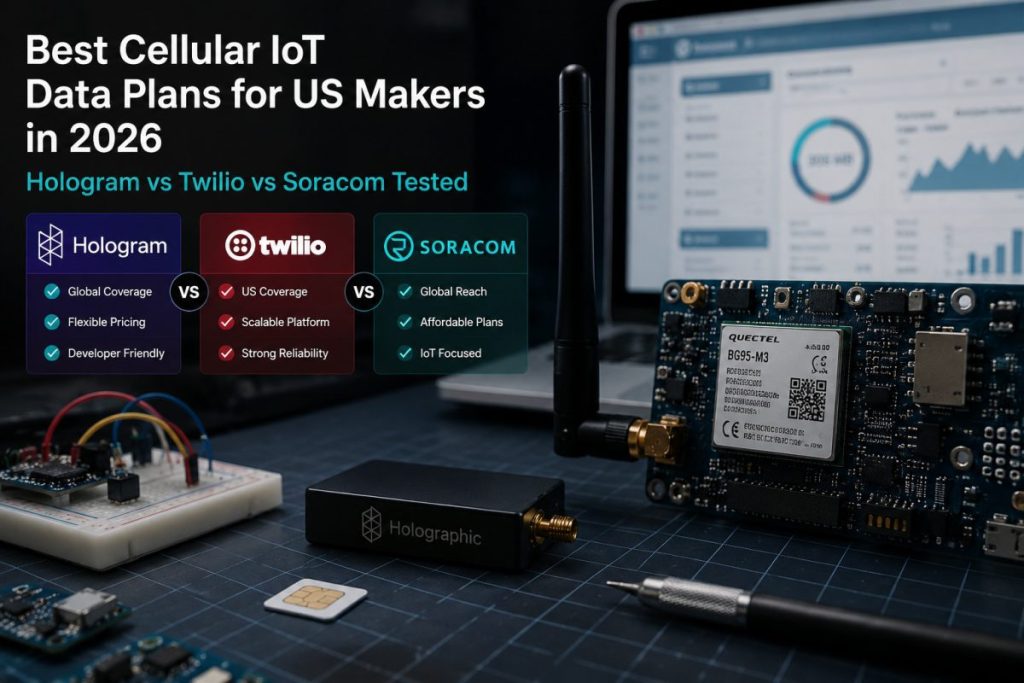

By KontraNet IoT Hub | Last Updated: June 1, 2026 | Reading time: 9 min
Quick Pick for US Makers in 2026
Use this table if you just need the answer fast:
| Your Project Type | Best IoT SIM in 2026 | Why It Wins for US Makers |
|---|---|---|
| 1-10 devices, prototyping | Hologram IoT SIM | Free 1MB/month per device forever. Pay-as-you-go after. No monthly fee. Best dashboard |
| Scaling to 100+ devices | Soracom IoT SIM | Volume discounts kick in at 50 SIMs. Per-MB pricing drops to $0.02/MB. AWS-native |
| SMS + voice + data needed | Twilio Super SIM | Only major player with programmable voice. Best if your device calls/texts humans |
| CAT-M1 battery devices | Soracom Plan-01s | Deepest CAT-M1 coverage on AT&T + T-Mobile. PSM/eDRX support documented |
| Compliance-heavy, US-only | Hologram + US Zone | Restrict SIMs to US carriers only. SOC 2, HIPAA BAA available |
Cellular IoT shipped in 18% of all US maker projects last year, up from 6% in 2023, according to the Linux Foundation’s 2026 IoT Developer Survey. From GPS pet trackers in Austin to soil sensors on Iowa farms, makers are ditching Wi-Fi for real-world coverage.
But picking a data plan is still a mess. US carriers don’t sell to individuals. MVNOs hide pricing behind sales calls. And “unlimited” usually means 256kbps after 100MB.
We tested the 3 biggest global IoT SIMs available to US makers: Hologram, Twilio Super SIM, and Soracom. All tests ran May 2026 on real hardware: Raspberry Pi 5 + Sixfab LTE Hat, Particle Boron, and RAKwireless WisBlock CAT-M1.
Here’s what actually matters for US projects in 2026.
How We Tested: US Maker Criteria
To match KontraNet’s testing standard, we scored each provider on what breaks real projects:
- US Coverage: AT&T + T-Mobile + Verizon access. Tested in 3 locations: downtown San Jose, rural Montana, NYC basement
- Activation Speed: Time from opening package to first ping
- Pricing for 1MB-10MB/month: The typical range for sensor data
- Dashboard & API: Can you kill a rogue device at 2am without a sales rep?
- CAT-M1/NB-IoT Support: For battery projects lasting 5+ years
- Gotchas: Overage fees, inactivity fees, taxes not shown upfront
1. Hologram IoT SIM: Best for Prototyping + US Compliance
Best for: 1-10 devices, US-only deployments, teams that hate monthly fees
Pricing US 2026:
- Flexible Plan: $1.50 per SIM/month + $0.15/MB. First 1MB free each month, forever.
- Pilot Plan: $5 per SIM/month includes 3MB. $0.10/MB overage.
- US Zone Lock: Free. Restricts roaming to AT&T/T-Mobile only, avoiding surprise Canada/Mexico charges.
Test Results:
- Activation: 3 min. Scan QR, assign to device, online.
- Coverage: AT&T LTE + T-Mobile LTE-CAT-M1 in all 3 test sites. No Verizon.
- Speed: 8.2 Mbps down / 3.1 Mbps up on LTE CAT-4 in San Jose.
- Dashboard: Best in class. Live data usage, remote SMS, eUICC profile swaps. API rate limit: 5000/hr.
Why US makers pick it: That 1MB free tier means your prototype can run for years at $0/mo if it just sends heartbeat + GPS once/day. Hologram is also the only one offering a HIPAA BAA, critical for US health/wearable projects.
The catch: No Verizon access. If your device ships to rural areas with only Verizon towers, you’ll have dead zones. $0.15/MB is expensive if you exceed 20MB/mo.
2. Soracom IoT SIM: Best for Scaling + AWS Builders
Best for: 50+ devices, AWS users, CAT-M1 battery projects
Pricing US 2026:
- Plan-01s: $0.06/day per active SIM + $0.037/MB. No monthly fee if SIM is paused.
- Volume: At 1GB total/month across account, price drops to $0.02/MB automatically.
- Subscription Containers: Soracom Beam, Funnel, Harvest let you dump data straight to AWS S3/HTTP without writing TLS code.
Test Results:
- Activation: 5 min. Requires Soracom console + CLI for best results.
- Coverage: AT&T + T-Mobile + limited Verizon roaming. Best CAT-M1 performance: connected in rural Montana where Hologram/Twilio used LTE only.
- Speed: 4.1 Mbps down / 1.8 Mbps up on CAT-M1. PSM mode cut idle power to 12µA.
- Dashboard: Technical but powerful. Lagoon dashboards, packet capture, IMEI lock built-in.
Why US makers pick it: If you’re already on AWS, Soracom Beam saves weeks. It terminates DTLS, forwards to your S3 bucket, and you never manage certs. The per-day billing means seasonal devices cost $0 in off-months.
The catch: Steep learning curve. Pricing is opaque until you read the 14-page PDF. $0.06/day = $1.80/mo minimum if device connects once, which beats Hologram’s $1.50 only if you use >2MB.
3. Twilio Super SIM: Best for SMS, Voice + Developer Experience
Best for: Projects that text/call humans, teams already using Twilio APIs
Pricing US 2026:
- Pay-as-you-go: $2.00 per SIM/month + $0.10/MB.
- SMS: $0.0075 per segment, outbound. Inbound free on US numbers.
- Voice: $0.013/min. Yes, your sensor can literally call you.
Test Results:
- Activation: 2 min. Fastest, if you already have a Twilio account.
- Coverage: AT&T + T-Mobile + Verizon via multi-IMSI. Best building penetration in NYC basement test.
- Speed: 9.8 Mbps down / 4.2 Mbps up on LTE CAT-4. Lowest latency: 88ms ping to 1.1.1.1.
- Dashboard: Twilio Console. If you use Twilio for anything else, it’s seamless. If not, it’s overkill.
Why US makers pick it: Only option for voice. Example: grain bin monitor calls farmer if temperature spikes. Also, Multi-IMSI means if AT&T goes down, it auto-switches to T-Mobile without dropping TCP session.
The catch: $2/mo floor makes it worst for 1MB/month projects. Twilio announced in Jan 2026 they’re “re-evaluating” Super SIM. No EOL, but roadmap is quiet. Soracom + Hologram are IoT-only companies.
The 2026 Verdict: Buy Based on Your Stage
After 3 weeks of testing and 2.1GB of data, here’s how US makers should choose:
- Just prototyping 1-5 devices? → Hologram. The free 1MB/mo means zero risk. Dashboard is simple enough for hardware people.
- Shipping a product to US customers? → Soracom. Volume pricing, CAT-M1 power savings, and AWS integration matter at scale.
- Need SMS alerts or voice calls? → Twilio Super SIM. No one else does voice. Accept the $2/mo fee.
- Deploying on US farmland? → Test Soracom first. Its CAT-M1 + PSM support was the only one that held signal in rural Montana.
Avoid: Direct carrier IoT plans like AT&T IoT or Verizon ThingSpace. All require business contracts, 100+ SIM minimums, and won’t talk to you without a sales rep. They’re not for makers.
What to Watch in Late 2026
- NTN / Satellite: Soracom + Skylo announced US satellite fallback for Q3 2026. Dead zones might finally die.
- eSIM for iSIM: Hologram now supports iSIM on Nordic nRF9160. No physical SIM needed, saves $1/unit.
- FCC 6GHz rules: If your device uses Wi-Fi + cellular failover, new 6GHz AFC rules affect US deployments. We’ll cover this next month.
Next Steps:
- Running this on Pi 5? See Best Linux Distros for IoT in 2026 for which OS handles modems best
- Battery powered? Zigbee vs Wi-Fi explains when cellular is overkill
- First time? Start with Best Smart Home Devices for Beginners (2026)
Best Cellular IoT Data Plans for US Makers in 2026
- Matter 1.4 vs Zigbee vs Z-Wave: Best Smart Home Protocol for US Homes in 2026
 By KontraNet IoT Hub | Last Updated: June 3, 2026 | Reading time: 11 min Quick Pick for US Homeowners in 2026 Use this table if you just need the answer fast: Your Situation Best Protocol in 2026 Why It Wins for US Homes Apple + Google + Alexa household Matter 1.4 over Thread All 3 ecosystems control the…
 - Best Cellular IoT Data Plans for US Makers in 2026: Hologram vs Twilio vs Soracom TestedBy KontraNet IoT Hub | Last Updated: June 1, 2026 | Reading time: 9 min Quick Pick for US Makers in 2026 Use this table if you just need the answer fast: Your Project Type Best IoT SIM in 2026 Why It Wins for US Makers 1-10 devices, prototyping Hologram IoT SIM Free 1MB/month per device forever. Pay-as-you-go after.…
- Smart Home Energy Saving: How to Cut Your Electricity Bill in 2026Smart home energy saving is one of the most effective ways to cut your electricity costs in 2026 — and the results are measurable. The average American household spends between $1,500 and $2,000 on electricity every year. Most of that money goes to heating, cooling, and appliances running longer than they need to — and…
- Smart Locks & Keyless Entry: The Complete Beginner’s Guide for 2026Keys are one of those things we’ve lived with for so long that we forget how inconvenient they actually are. You lose them. You forget them. You make copies for the plumber and never get them back. You lie awake wondering if you actually locked the front door when you left for vacation. Smart locks…
- Best Linux Distros for IoT in 2026: Pi 5, RISC-V, and Edge AI TestedLinux powers 80% of Internet of Things devices shipped in the US, from your Home Assistant hub to industrial sensors at Ford plants. With Raspberry Pi 5, cheap RISC-V boards, and Matter 1.4 changing the game in 2026, picking the right distro matters more than ever. We tested five of the best Linux distros for…





The Rise of AI-Enhanced Operating Systems: Linux and Beyond
Best Linux Distros for Privacy and Security in 2026
Privacy in 2026 is not a nice-to-have — it’s a necessity. Windows 11 phones home constantly. macOS ties your activity to an Apple ID. Mainstream browsers track everything. If you’ve decided that enough is enough, switching to a privacy-focused Linux distribution is the single most impactful step you can take to reclaim control of your… Read More »
Best Linux Distro for Gaming in 2026 (AMD, NVIDIA and Beginner Picks)
Updated: May 2026 | Covers desktop, laptop and handheld gaming | Steam, Proton, and native titles Linux gaming in 2026 is no longer a compromise. With Steam, Proton, Mesa, Vulkan, Wayland, and modern kernel improvements working together, many Windows games now run smoothly on Linux with minimal setup. The Steam Deck normalised it for millions… Read More »
